in memoriam: jorge frascara (1939-2026)
02.03.2026 ICoD news
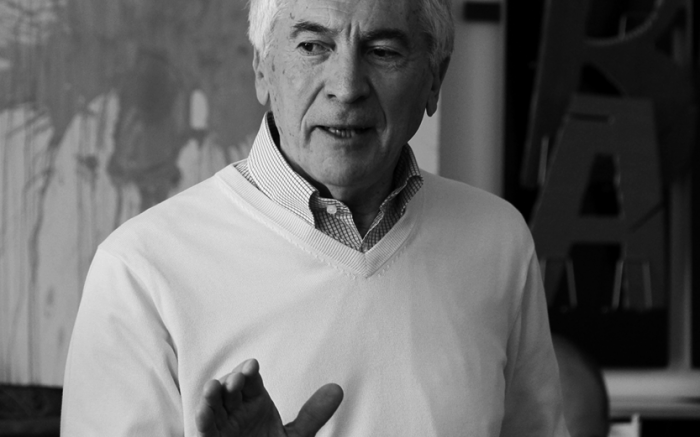
It is with deep sadness that we announce the passing of our dear friend and colleague, Jorge Frascara, former President of ICoD. He passed away in late February 2026 at the age of 87 in Lucerne, Switzerland, where he had been living with his wife, Dr Guillermina Noël, for the past few years. He was one of the most influential figures in Canadian and international communication design, research, education, and leadership.
Jorge was born in Buenos Aires, Argentina, in 1939. The son of a journalist and a poet/painter, he studied at the Escuela Nacional de Bellas Artes Prilidiano Pueyrredón in Buenos Aires and began his professional career as an illustrator and film animator in the early 1960s. He served as Head of Graphic Design at the Escuela Panamericana de Arte in Buenos Aires from 1972 to 1976.
Jorge’s diverse interests in culture, art, design, education, psychology, and communication led him to various avenues of inquiry. In 1973, he spent a year working in Guatemala and a year studying in London with a British Council grant on graphic design education. During his time in London, he met three influential people: Herbert Spencer, who inspired him to adapt Spencer’s field research methods for legibility to other communication design areas; and Patrick Wallis Burke, then editor of Icographic magazine, and Marijke Singer, then Secretary General of Icograda, which resulted in a long-lasting relationship with the International Council of Graphic Design Associations (Icograda, now Ico-D).
Upon his return to Buenos Aires, Jorge organised a meeting with colleagues and founded the first Society of Graphic Designers of Argentina. In 1974, he coordinated a public information symbols test station in Buenos Aires at the invitation of the International Standards Organisation (ISO) and began field research in communication design. Notably, he presented a study on children’s preferences for illustration styles at the Icograda Edugraphic conference in Edmonton in 1975, which was subsequently published in Icographic and two other scholarly journals.
In 1976, Jorge moved to Canada and took up a position at the University of Alberta. He became Chairman of the Art and Design department (1981-1986) and later Professor Emeritus. During his time there, he helped establish a highly regarded design programme and mentored many designers who have influenced practice in Canada and beyond. Jorge was also appointed Honorary Professor at Emily Carr University, Canada; Advisor to the Design Doctorate at IUAV University of Venice; and Advisory Board Member at Master Design Hochschule Luzern, where he taught part-time. His education career and appointments demonstrate his visionary work in establishing design as a discipline grounded in ethics, research, and social responsibility.
Beyond his teaching, his legacy includes a vast body of published work as an editor and author, many in English and Spanish. Some key titles that shaped contemporary design theory and practice are Graphic Design and Communication (1988), which establishes the foundations of communicational thinking applied to design; Graphic Design for People: Mass Communications and Social Change (1997); “Design and the social sciences: Making connections” (2002); Communication Design (2006), an expanded update of that approach; and What is Information Design? (2011), which addresses design as a discipline at the service of clarity and informational effectiveness; Information design as principled action: Making information accessible, relevant, understandable, and usable (2015); and Teaching Design: Users, Contexts, Objectives, and Research Methods (2018), which explores methods and challenges for training new generations of designers.

Jorge edited Graphic Design: World Views – A Celebration of ICOGRADA’s 25th Anniversary. This book, designed by Niko Spelbrink and cover illustrated by Grapus, was published by Kodansha. It featured 35 authors from around the world and explored graphic design over 25 years, beginning with ICoD’s founding in 1963.
Jorge served on the editorial boards of Design Issues (Carnegie Mellon University/MIT), Information Design Journal (John Benjamins), and Tipográfica (Buenos Aires, Argentina). He was also an International Fellow of the Society for the Science of Design (Japan) and organised international design education projects, advised and reviewed design education programmes and journals, and lectured in 26 countries.
Jorge’s leadership and professional management were commendable. He served as an elected member of the National Council of the Society of Graphic Designers of Canada (1979–81) and on the Advisory Committee on Graphic Symbols for the Canadian Standards Council (1979–90). His tenure advanced professional standards, strengthened national dialogue on design ethics, and reinforced the importance of research-informed practice in Canada. In 1985, he was awarded Fellowship by the Society of Graphic Designers of Canada, now known as the Design Professionals of Canada (DesCan).
In 1975, Jorge participated in the organisation and spoke at the Icograda Edugraphic ‘75 conference, the first international conference on design education in North America and the first Icograda conference outside Europe. This involvement led to his active participation in Icograda’s activities, exposing him to the international design industry. From 1977 to 1981, he served as the Icograda representative, and in 1986, became convener of the ISO Working Group on Graphic Symbols for Public Information (ISO TC 145 SC1 WG2). In this role, he led the development of the ISO Technical Report 7239, establishing frames of reference for the sizing and placement of graphic symbols for public information in public spaces.
Jorge served four terms on the Executive Board of Icograda (now ICoD). He was Vice President from 1979 to 1981, President Elect from 1983 to 1985, President from 1985 to 1987 (the first Latin American President), and Past President from 1987 to 1989. In these roles, he helped shape the organisation’s global direction at a pivotal time in its history.
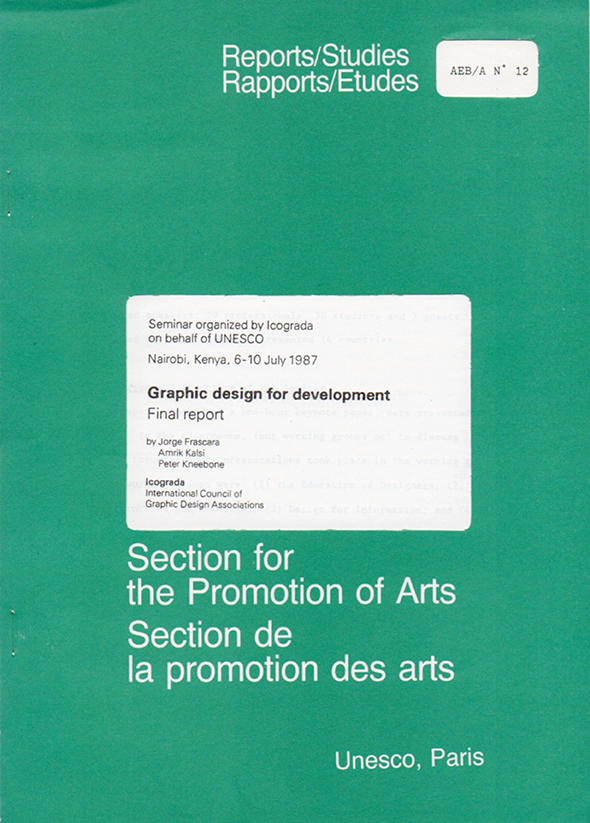
In 1987, Jorge collaborated with Amrik Kalsi and Peter Kneebone to organise the Graphic Design for Development Seminar in Nairobi, Kenya, in collaboration with UNESCO. This resulted in UNESCO including ‘design’ as part of its scope of work.
In 1979, Jorge co-led an Icograda design student project to create graphic symbols for public information. Students from around the world designed and developed test symbols for the ISO. Twenty schools from 13 countries participated, producing over 1,000 symbols that led to ten new international standards. In 1980, Jorge delivered the opening address at the Icograda Latinoamérica regional conference in Guadalajara, Mexico, titled ‘Graphic Design in Latin America’. The event was the first of its kind in the region and had a great impact on expanding Icograda’s footprint in Latin America. In 1982, he also participated in the first Icograda Africa Regional Meeting in Port Harcourt, Nigeria. From 1981 to 1984, Jorge served as Associate Editor of Icographic Volume 2, reviving the work of his friend, Patrick Wallis Burke. Under his editorship, six themed issues were published, with abstracts in four languages.
In 1987, Jorge collaborated with Amrik Kalsi and Peter Kneebone to organise the Graphic Design for Development Seminar in Nairobi, Kenya, attracting 91 participants from 14 countries. A month later, he presented the paper ‘Graphic Design: Fine Art or Social Science?’ at the Design ’87 Icograda, ICSID, and IFI joint congress in Amsterdam, which gained significant attention and became one of his most read texts. In 1990, Jorge edited Graphic Design, World Views: A celebration of ICOGRADA’s 25th Anniversary, designed by Niko Spelbrink and published by Kodansha. In 1987, he edited the Icograda publication Projects in Graphic Design Education as well as A Bibliography for Graphic Design History with Victor Margolin.
In 2013, ICoD presented Jorge with an Achievement Award, along with fellow Canadian ICoD Former Presidents Walter Jungkind and Robert L. Peters.
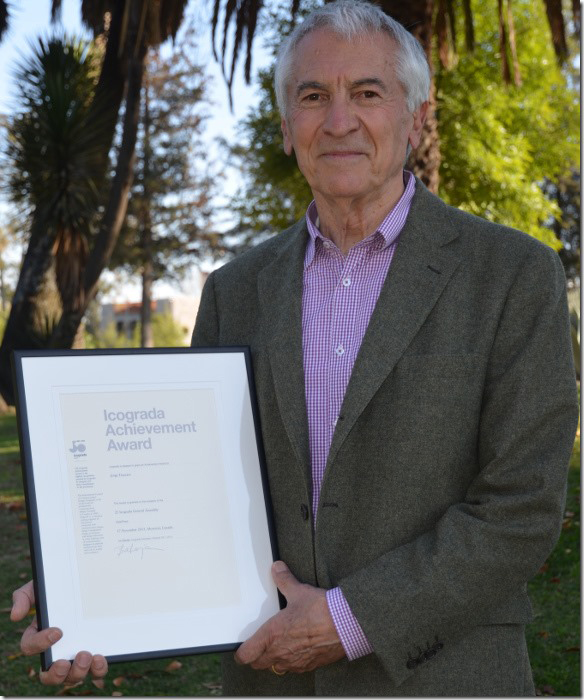
Jorge was honoured with an ICoD Achievement Award in 2013.
Jorge also worked as a designer, and his practice included illustration, animation, advertising, social marketing, and editorial and information design, often under the name Frascara-Noel, the company which he ran with his wife, Dr Guillermina Noël. His clients include the Government of Canada, the Government of the Province of Alberta, Telus Canada, Alberta Drug Utilisation Company, Mission Possible Traffic Safety Coalition, Alberta Energy Company, the International Geographical Union, and the Emilia-Romagna Health Assessment Centre, Italy. He also served as an International Advisory Board member of the Swiss Centre for Design and Health.
In 2013 Jorge wrote:
“Icograda was a remarkable experience for me, it allowed me to have a rich and varied view of the graphic design world, and provided me the possibility to get to know and work along with remarkable people that taught me important things, that made me grow very fast, sometimes because of a gesture, sometimes because of their work, sometimes because of their generosity, sometimes because of their wisdom; I will always take them with me, wherever I go…”
 Featured with Jorge (centre front) are former presidents (LtR) Don Ryun Chang (South Korea), Russell Kennedy (Australia), Jacques Lange (South Africa), David Grossman (Israel), Robert L. Peters (Canada) and Iva Babaja (Croatia) at 2013 General Assembly in Montreal, Canada.
Jorge’s ICoD colleagues share the following memories and messages:
“I am deeply saddened to learn of the passing of Jorge Frascara, a respected educator, author, and thinker whose work helped define and strengthen the field of communication design. Through his contributions to ICoD, in its earlier years as Icograda – its areas of concern, its working methods, and its purposes – consistently foregrounding the responsibility inherent in the discipline and framing it as a practice shaped by research, context, and social impact. Through his contributions to ICoD, in its earlier years as Icograda, he enriched the international design community and helped shape the intellectual discourse that continues to guide our organisation today.
On behalf of the International Council of Design, we extend our sincere condolences to Jorge Frascara’s family, colleagues, and the global design community. His legacy will endure through the institutions he strengthened and the generations of designers he influenced.”
– Melike Taşcıoğlu Vaughan, ICoD President, 2024-2026 (Türkiye)
——
“I had the honour of meeting Jorge in 1997 at my first ICoD (Icograda) General Assembly in Punta del Este, Uruguay. I was struck by the elegance of his presence – articulate, generous, and calmly assured – as a former President who made cross-cultural exchange feel both natural and necessary. His legacy will be the bridges he built across continents, disciplines, and educational institutions, inspiring countless designers to join our Council, serve in leadership roles, and become committed advocates for our international design community.”
– Don Ryun Chang, ICoD President, 2007-2009 (South Korea)
——
“Having become aware of Jorge’s work during my student years and later meeting him in person, I have always been in awe of his ability to inspire designers of all cultures and ages through his books and theories. When he spoke, he did so gently, always with a smile, yet his messages were powerful, urging us to observe and listen intently, and question everything in pursuit of design that does good.”
– Jacques Lange, ICoD President 2005–2007 (South Africa)
——
“Jorge clearly articulated how communication design should be both professionally framed and taught. He passionately, and successfully championed and wrote about design, respectfully positioning it as a problem-solving practice operating across emotional, rational, systemic, technological, and social levels of communication grounded in context, ethics, and responsibility.”
– Russell Kennedy, ICoD President 2009–2011 (Australia)
——
“Jorge’s legacy in Canada and internationally is profound. A generation of educators, practitioners, and leaders carry forward his belief that design must serve people first. He leaves behind a body of work and a professional ethos that will continue to guide design communities for decades to come.”
– Johnathon Strebly, ICoD President 2019–2022 (Canada)
——
“Jorge and I first found each other through Icograda — that particular community where we gathered to argue about what design is for and what it might yet become. He took those questions seriously, and his thinking about design's potential — especially as seen through a Latin American lens – became a point of view that I deeply trusted and valued. But what I will carry is not the conference talks or his books. It's the notes. Jorge had a gift for the small, generous gesture: a restaurant recommendation in Buenos Aires, a suggestion of something worth doing in Santiago, a line or two that said, ‘ I thought of you.’ It is a rare quality – to hold serious intellectual convictions about the purpose of your work, and still find room to care about where a friend might have a good meal. Jorge did both, effortlessly.”
– Brenda Sanderson, ICoD Managing Director 2005–2012 (Canada)
——
“Jorge Frascara's contribution to Icograda/ICoD is notable on a number of fronts. Upon establishment, the organisation was primarily focused on market-driven professional issues. Jorge represents the expansion of community perspectives to include an educational point of view. In the ensuing decades, this approach resulted in an evolving comprehension of ‘professionalism’ that had important social and ethical implications – and which eventually signified a differentiation between Icograda/ICoD and other international design organisations.”
– David Grossman, ICoD President (1999-2001, 2015-2017)
relatedarticles
PM2026

International Design Day 2026 Recap: The Spaces In Between

ICoD finds a new home in Vilnius